Thursday, July 29, 2010

Guess who's back--/--/--Shady's back!

I have been away for a while.
I still have to get the new habit of blogging regularly. I have been working on the instrument, but not sitting down and recording it.

So, what have I done? (with pictures)


1)  I finally got my parts, so I reassembled the keyboard, with new felt punchings.


The keyboard still needs to be leveled, but before I do that, I have to deal with the broken key tops.  More of that later.

So, I put all the keys back, and reinstalled the Hammer Shank Rail, preparatory to reassembling the instrument, for a trial. Here is what it looked like before I put it back together.


 In the meantime, I have been working on my patio garden. Here are pictures:


   So, what I have to do now is make some key decisions about the keytops. (See what I did there? That's cause I am a writer!) I ordered so far, 14 ivories from International Piano Supply, at $4 a pop. Half of them are too white. I am going to write and see if I can send them back for some yellower ones. I am also considering swapping some of the extreme high and low keys, for the missing keys in the center of the keyboard, and then putting the replacements on the ends of the keyboard. Unfortunately, on this instrument almost half the white keys could use replacing. Certainly no fewer than 21 of the 55 white keys are visibly broken on the edges. There are two I could overlook, and three I have filed the small chips smooth, but maybe I should just put a set of plastic keytops on for the visual beauty. Ivory is nice if it is uniform, but that may be a problem. I dont know yet.

  Anyway, I put it back together, and now, for the first time on the internet, is the sound of 1867.  This is David Sonsara, my teacher, playing the Beethoven variations on a theme by Paisiello, just the sort of music appropriate to this instrument. Take it away, David!


As you can see, it plays very nicely. It needs key leveling, as I said before, and it needs regulation very badly, but the worst key, middle G, I think I fixed. The hammer back-check needed adjustment. It was impeding the rise of the hammer on the key strike. I bent the wire back a couple millimeters, and I think that solved that problem. But I won't know until I put it all back together again, and that won't be for a while, now.

 I am at a kind of standstill right now. I have to decide what to do with the keyboard, so I can level it, then I can regulate the mechanism, and refinish the hammers, and then I can put it back together to see how it works.

Then the strings!

Sunday, July 4, 2010

Waiting for the Postman


I guess I should add an entry, for the benefit of my millions of readers. I just made a big order, felt and paper punchings to level the keyboard. And a bunch of miscellaneous pieces of felt, and another dozen ivory key tops. Now I will have 14. I counted 25 chipped keys, with about 11 of them very badly chipped. I guess I am committed to ivory.

I have finished polishing the 85 individual keys with 00 steel wool, and brushed out the flanges and pin holes. Some interesting finds. Two of them are signed. The 85th key is signed in pencil, on the side, "Dahlquist". And the first key is signed in pencil "Dahlquist", but in a different handwriting! What to make of that? Father and son? The foreman wrote Dahlquist's name on the job, and he signed it at the end? He had a stroke between key 1 and key 85??? Key No. 1 is also stamped with the name E. Larson, with a punch stamp. And the first set of keys has 5 and 3 punched on them in the vicinity of the action. Wish I knew what it all meant.

Of course, I haven't been able to play it for a month now. Don't know when I will be able to again. Probably in a couple months, when I get the action all regulated.

But I have been playing my Kawai, which I was badmouthing so bad in the first entry. I should apologize to my poor little upright. It's a very nice piano. I and preparing for piano club next Saturday. I will play Diabelli variation No. 2, which is a real devil, and the first movement of Sonata VIII by Friedrich Wilhelm Rust, my current favorite obscure composer.

Piano Club is a monthly social for about a dozen or two of us who like to play, but are not Paderewski, so we play for each other. It is a very diverse group of men and women, many quite proficient in various genres. About half are like me, slaves to the page, and half can improvise freely from a lead sheet, or ad libitum. I am so jealous, I wish I could do that. It is a mystery to me why I can sit here and type out my thoughts as words on this keyboard, but I can't type out my thoughts as music on the piano.

But having joined Piano Club has changed my entire outlook on practice. Now that I have the prospect of performing, I can't overlook my little glitches, like I did when I was just playing for myself. Now I focus on the mechanics of the finger fumble, and figure out where I got lost. When I was playing just for myself, I just ran the right stuff through my head, and ignored my actual performance. But you can't do that for other people. So I am still not Paderewski, but I am learning how to study for performance now, and making leaps and strides in my execution.

Yay. Also I get to share my obscure music with other people, which is even better. Next month I am doing Gottshchalk's "Morte: She is Dead", and after that Rossini's "Une Caresse a ma Femme". And I think after that, the Froberger Lamento for Ferdinand III.

Sunday, June 27, 2010

someone else's story

http://www.burningbuilding.com/piano.htm

Here is a funny link. It's a story about an expedition working its way through the insides of an upright piano.

Thursday, June 24, 2010

Clean Keys and Dirty Keys


Nothing much these days. I am regrouping, and back to slow piece by piece cleaning.

Having removed the hammer shank rail, and pulled out the keys, I am polishing them one by one with 00 grade steel wool. They come off the instrument grey with age and dust, and with the application of steel wool and elbow grease, they are restored to their warm reddish gold hue. The tops are thick with dust, the sides with crystalized sap that has exuded over the last century and a half, and the bottoms are stained from the felts they sit on. Then I spend five minutes on one, and it glows.

I set up my table, and watch an episode of standup comedy on streaming Netflix. Now I wear gloves, after the first couple sessions of chewing up my finger tips with steel wool. I brush off the loose dust with a cotton cloth, then rub down each surface with the wool. Some of the keys are stained from a spill, but that comes out with a good polishing.

It takes five or six minutes to do one key. Ten an hour. Eighty five keys in eight and a half hours. I have about forty left to finish. I have been doing six to ten each morning. Hey, it's my hobby not my job!

I have to order the front rail and balance rail felt and paper punchings. Then I can level the keyboard, and one major task will have been accomplished. Oh, I also have a handful of ivory key tops to put on. I don't know if I should replace the broken ivories, or if I should just install a new set of plastic key tops. I am inclined to the ivory, for authenticity, but a set of new bright keys sure brings a piano to life.

Decisions, decisions.

Friday, June 18, 2010


Well, after my first setback, I took a few days to regroup. I decided to let the dampers wait for a while, and take a look at the action. So, I headed to the thrift store for a work table. I found a nice one for a bargain price, and brought it home.


I removed the key-bed/action, and set it on my table. I took a couple pictures of it like that, but they seem to have disappeared from my camera.
So, first thing, figure out how to get the keys out, for leveling. Hah! Easier said than done. Those keys were locked in there by the hammer rail, and of the 85 keys, I was able to wrangle only about 25 out of the middle section, where there was enough wiggle room to get the first key out, and then contort the next and the next, until I had a set removed.

Boy, was that keybed filthy. There was a hundred fifty years of dust and lint under the keys. The dust was as thick as the felt punchings that sit at the bottom of the key front rail. Nasty!

I took the soft brush to it, and cleaned it all out.

Then, one by one, I removed the felt and paper front rail punchings and ccarefully set them aside in order, white keys in front, black keys in back. Except for being dirty, the felts are in quite good condition.

But now I was stymied. I could not pry any more of the keys out of the action. Now I had to examine the action more closely, to see what needed to be removed.

This is such an elegant little machine. It has the barest minimum of moving parts, unlike modern machines that may have thirty to seventy pieces for each action. There is not much that is liable to regulation. There is a check screw, and there is a pair of adjusting screws for the jack flange, to move it up or down. But that is it!

Again, I am amazed at how well made this is. It is entirely of wood, except for the screws and the cast iron frame. But it is absolutely solid, and the felt parts, the bumpers and so on, are in great condition. The buckskin parts are a little rough, but I can polish them down. I am wondering how many parts I am really going to have to replace in the action. Not a lot.

Saturday, June 12, 2010

HIstorico-philosphocal Musings

My first, abortive, excited foray into restoration, has, so to speak, set me aback, a bit.

This one job, the damper felts, is not going to be the work of an afternoon, as with a modern piano, with standardized, rectilinear felts, that can be glued onto a flat damper head surface.

This is an antique instrument. It is close to 150 years old. It was built by hand, in a "new", "modern" factory in New Haven, Connecticut, around 1867. The factory made all its parts, from casting the frame, to cutting the wood action parts. I don't know if they pressed their own felt. Probably they contracted it. New England at the time was the major industrial manufactory for textiles and fabrics.

This was the post-war period when the war time industrialists were converting to peace time production, expanding west with the railroads and the civilizing mission. A number of investors came to Frederick Mathushek with the idea of starting a company to produce his designs. Mathushek was a German immigrant, who was highly regarded as a piano engineer. According to some accounts he invented overstringing, although I guess the Steinway Company first used it in production models..
Mathushek was well known as a designer of scales, that is balancing the interacting factors of length, weight and tension of the sequential strings, to produce the best sound, in a given wooden box.
Pianos produce sound when hammers hit the strings, and the strings vibrate. If you used the same weight of strings from top to bottom, the piano would have to be forty feet long, for the bass strings. If you used the same wound strings from bottom to top, the short strings would be too thick and heavy to vibrate at all.
And if you used the same string length from bottom to top, and tuned them by tightening them, like with a rubber band, you would have to pull the top strings so tight, they would break.

So, Mathushek designed a couple of square pianos for production. He designed the Orchestral Grand, which was a standard square grand, over six feet by four feet, and seven and a half octaves.

He also designed the Colibri Model, which this one is. It is a smaller instrument, with three fewer keys at the bottom end, saving about a foot of length in the instrument.

He opened the factory in New Haven in 1866. I have seen a catalogue from 1871, and all the instruments have fancy french legs. I searched for a long time until I found a picture of one with octagonal legs like mine, with the note that those legs went out of style after 1867. And since my serial number is 3003, I am venturing to date my instrument to 1867 or 1868 at the latest. Paul Robinson of Acme Piano Company in San Diego, want to put it a year or so later. I don't know how many instruments they produced in a year. More than a thousand? More than three a day? Somehow that doesn't seem likely. Who knows? If anyone has any information, let me know.

So, back to philosophico- part. I am only gradually beginning to grok the fullness of my instrument. It is a beautiful piece of 19th Century machinery. The cabinet is subdued, not extravagant as American Victorian furniture, and pianos, often were. The machine part, the action and the frame, are very elegantly designed. For instance, the damper assembly has lifters for each individual set of strings. But since the strings are overstrung, that is, the bass strings cross over the treble strings, there is a space of about six inches along the damper assembly where there are no strings to damp. Even so, Mathushek designed his assembly with six dummy damper arms to fill in the space. They lift when the damper pedal is depressed, and from the appearance, you would never know there is a gap in the line. Instead, you see an assembly with an attractive curve, and elegant long parallel arms.

So there is a design aesthetic going on here, as well. As I begin to understand the design and the mechanism, and compare it to modern instruments, I begin to understand the mind of the designer. This instrument has all the parts of any piano, but they are completely idiosyncratic, and I will have to figure out their quirks in order to restore this instrument to even 75 or 80% of its original musicality.

Friday, June 11, 2010

Oh, dear, first setback.

I decided to work on a section of the dampers, specifically, the seven dampers between C and F-sharp, below middle C, which are the last seven of the overstrung notes, and are bi-chords, that is, two strings to each note, and are wire. The rest of the overstrung sections are four wound bi-chords, and then twenty wound mono-chords, down to the low C. (Remember, this instrument has only 85 keys, and ends at C top and bottom.)

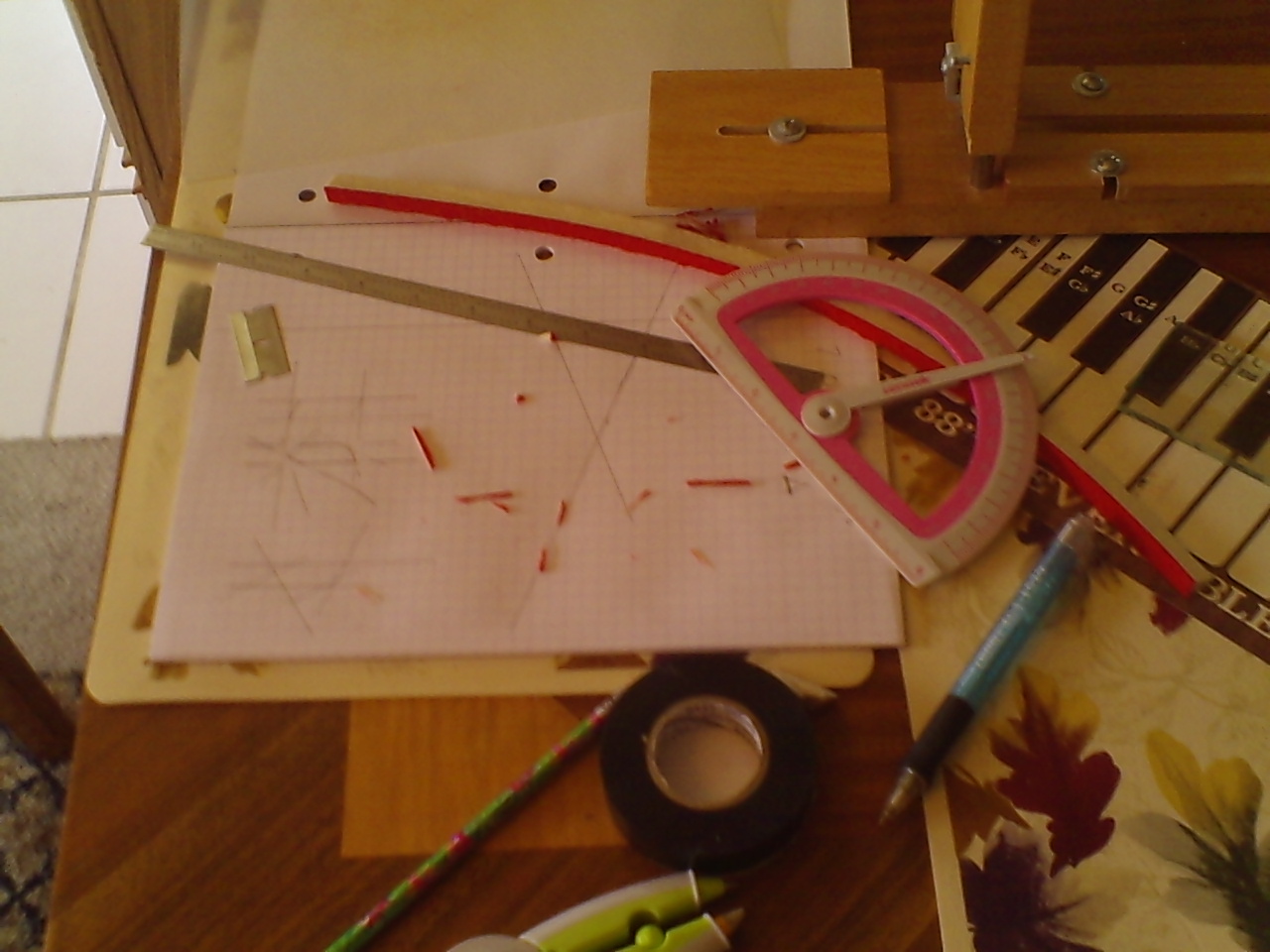
Well, the damper felts on there now are pretty distorted from their original shapes, after all these years. Using a protractor and graph paper, i drew a pattern for the shape of the felts. Oh, before all that, I had to measure the angle of the damper arms to the strings, which varies from 103 degrees to 110 degrees. So I made my diagrams and charts, and figured out how to cut my felts, to fit the peculiar shapes. Here are some pictures:


So, I cut my felts 1 1/8" on my little guillotine, and made the first 110 degree cuts, and after a couple discards, I had a set.


Here is a picture of the felts placed on the strings, in place, with the damper arms removed.


So I had my set of seven dampers, one of them trimmed into an irregular heptagon.


Meanwhile, I had removed the old felts from the damper arms with the simple application of hot water with a q-tip, and the glue easily dissolved, letting me peel off the fabric. Here are the clean damper arms laid out.


I let them dry out while I went to work today. Then, when I came home, I began to lay them out to reassemble them. This is when I began to realize that they were too wide, and would need to be trimmed by about a 16th of an inch on each side. But the real discovery was that the fancy bi-chord felt I was using, it got caught between the strings, and sounded them when it lifted. The original had flat felt pads, and I thought I would improve on Mr. Mathushek's design. What a Fool!
So, it's back to the design board again. Clearly every felt is going to have to be individually shaped.

Ah, well, that's what a hobby is all about!

I got a nice long straight-edge today, and a fresh bottle of glue, and some colored pipe cleaners so I can easily label strings and tuning pins and action parts and all.

But I am committed now. It is not playable any more. Work begins!